 scene memory
Before the Lyceum, before the warehouses, before anyone crowned me anything — there was walking.
It started with a move, and it started with friends.
The move first. In 1979 we went from the top of Camberwell Grove — right near the top of Dog Kennel Hill — down the Grove, right into Lyndhurst Grove, left into Lyndhurst Way. Measure it on a map and it's just over 1.1 miles. Barely a move at all, on paper. In real life it was a whole new world: new streets, new faces, new everything. That's the thing about South London nobody tells you — you don't need to cross a country to start a new life. A mile will do it. Eventually we landed at 80 Lyndhurst Grove, where I got the thing that made everything else in this blog possible: my own bedroom, up in the eaves. My kingdom under the roof — a Velux went in a few years later and made it official. One turntable, a growing stack of records, and a door I could close.
And then the friends. I'd made a couple — new South London friends, both from Jamaican families, and here I have to pause and ask the question I've been asking my whole life: what is it about Jamaicans? Because I have been drawn to that culture — the music, the sound, the style, the whole frequency of it — from the very beginning, before I could have told you why. It's a thread that runs through every chapter still to come, so consider this the first pull of it. More on that later. A lot more.
The friends gave the walking a purpose, and the walking gave me the map.
After school. Weekends. The long, shapeless weeks of the school holidays. If you'd wanted to find me in those years, the honest answer was: somewhere between Camberwell and Peckham, on foot, headphones on, gone.

our front door was a compass
Here's what you need to understand about our front door on Lyndhurst Grove. It was a compass.
Turn left, and I could walk into my own past. Camberwell. Denmark Hill. The house we used to live in, opposite Dog Kennel Hill — my old primary school sitting there like nothing had happened. Camberwell Grove with its grand old houses. I'd walk those streets like a visitor at a museum where every exhibit was me: there's where I played, there's the school gate, there's the old life, preserved behind glass. It's a strange hobby for a teenager, deliberately haunting your own childhood. I did it anyway. Some walks are just checking the past is still where you left it.
Turn right, and it was deep into Peckham — the present tense, the territory I was still learning, streets that didn't know me yet.
And straight ahead was the no-go area.
The North Peckham estate. The place adults mentioned in a lowered voice. The name that came with a warning attached, always delivered by someone who'd never actually been. Every part of London had one — the estate that carried the neighbourhood's whole reputation on its back — and ours was straight up the road from my front door.
So obviously, I walked there.
I'd love to tell you I strode in fearless. I didn't. What I had was a thrill going off inside me like a shaken bottle — scared, but only a little, and curious, curious most of all. And underneath the curiosity, if I'm honest with you from this distance: I wanted to meet people. I was the new girl. I'd been the new girl for a while. I wanted friends, and some part of me had worked out that friends were not going to be found in my bedroom, however good the records were. The no-go area wasn't a dare. It was a girl walking toward where the people were.

the soundtrack
Now — the soundtrack. Because none of these walks happened in silence.
You have to understand where music was at that moment. I was still reeling from what 1978 and '79 had done to the world — disco at its absolute imperial peak, the records that made everything before them sound black-and-white. The dust hadn't settled. And into that came Jimmy's box — and then, crucially, a discovery of my own: Red Records, on Rye Lane in Peckham.
The box was given to me. Red Records is where I went digging. A record shop of my own, walking distance from my front door, where the music didn't arrive by post from a ghost — you went in and chose. That's the difference between inheriting a taste and building one. Jimmy started the collection; Rye Lane is where it became mine.
I had one turntable and a tape deck, and I'd taught myself the sacred art of recording vinyl to cassette. Needle down, fingers hovering over record and play, breath held so the microphone gods didn't catch the sound of the house. Every C90 was a set: chosen, sequenced, mine. I didn't know it then, but those tapes were my first DJ sets. One deck, an audience of one, walking.
And what a setlist. Evelyn “Champagne” King, I'm In Love — brand new that year, all rush and shimmer. High Gloss, You'll Never Know. The Jackson 5, all of them, every era. Michael on his own. Gloria Gaynor. Disco into Motown into early R&B, all the way through, no filler.
Notice what that tape is: joy. Front to back. Love songs, disco strings, basslines that make pavement feel like sprung dancefloor. I walked through my old life, my new life, and the no-go area wrapped in the happiest music ever recorded. People talk about headphones as armour, and they were — but my armour wasn't toughness. It was joy at full volume. You try feeling scared with Evelyn King in your ears. It can't be done. The fear stays in your feet; the music keeps the rest of you dancing.
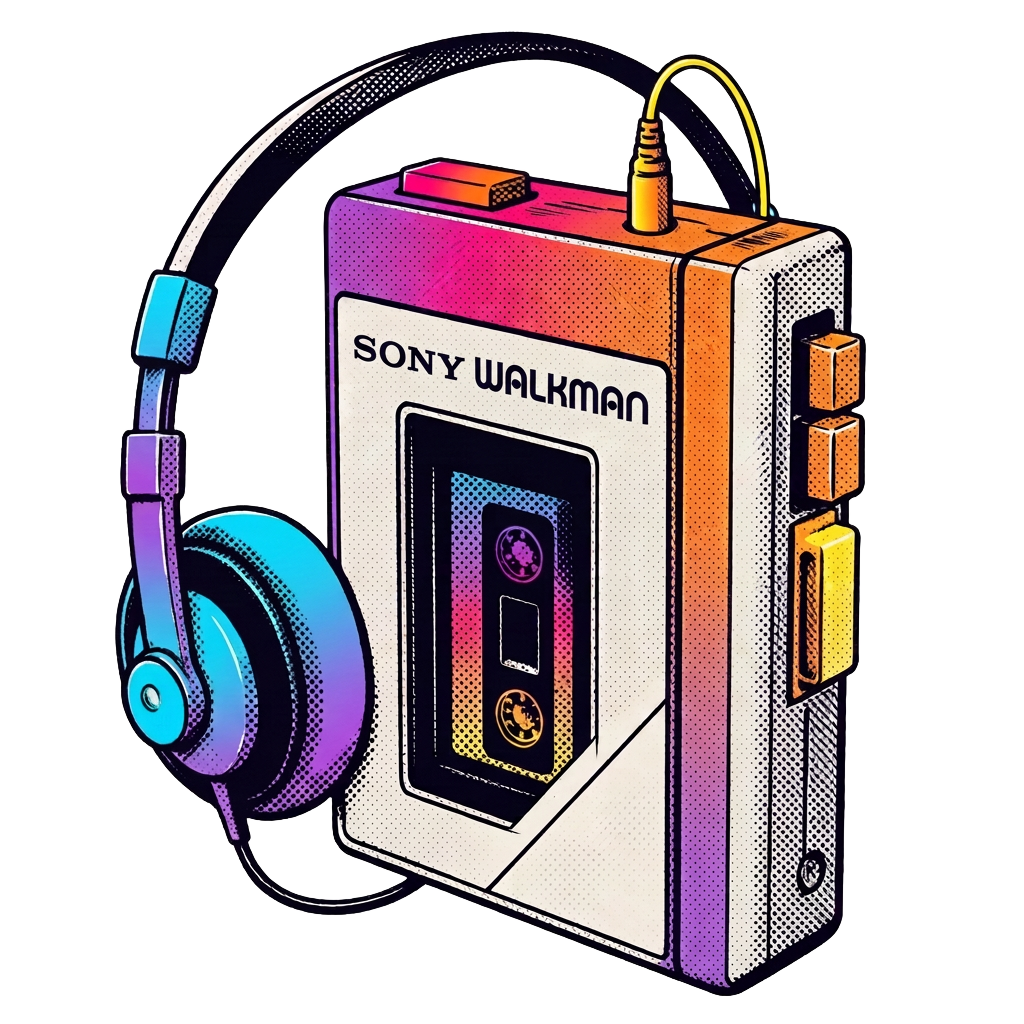
The Walkman was still box-fresh magic then. We were the first kids in history who could walk through a city inside our own soundtrack — private music, in public, in motion. Every street became a scene from a film only I could hear the score to. I was mapping South London one side of a C90 at a time, and everywhere I walked, the map came back marked in music.
the lost art of the wait
And the walking worked. Slowly, the way it does at that age, I found my people — and the map grew. I'd meet friends over in Brockley, which brings me to a lost art form that anyone under forty will never understand: the wait.
No mobile phones. No texting “here” or “running late babes.” You agreed a time and a place — days in advance, sometimes on a landline with a parent hovering — and then you turned up and you waited. And waited. Was she coming? Had she said the clock tower or the station? Was it three o'clock or half three? You had no way of knowing, so you stood there, one earphone in out of politeness to the possibility of her arrival, doing long stretches of absolutely nothing in a public place like it was a job. The waiting was its own era. Whole afternoons of my adolescence were spent waiting in Brockley, and honestly, the tapes are the only reason I remained sane.
But when everyone did turn up — that's when the real journey started. The number 171. Our bus. It carried us up out of South London and over Waterloo Bridge — and if you've never crossed Waterloo Bridge on the top deck at that age, with your best friends and a shared Walkman earphone and the whole river opening up on both sides, I can't fully explain it to you. That crossing felt like passing through a border. South London behind us, the West End ahead, and everything possible.
And on the other side, on the outskirts of Covent Garden, something was beginning. You could feel it before you could name it. London's hip hop scene was being born right there — lino on the pavement, radios, kids spinning on their backs while tourists gawped, the whole electric sense of a culture assembling itself in public, in real time. We'd stand at the edge of those circles and watch. The back row of the classroom had become a crowd in a piazza, and this time, nobody was telling me which row I belonged in.
Looking back, I can see what the walking years actually were. A girl with a box of inherited records, a home-taped set of the best music on earth, walking and waiting her way toward her people — from Lyndhurst Grove to Brockley to the top deck of the 171, each journey a little further from the bedroom and a little closer to the music.
What I needed next was a room. A big one. Full of people my age who knew every word I knew.
In 1983, I found it. On Wellington Street, off the Strand — and they let under-18s in. But that's the next story.